
A Seiko panda watch is worth considering if you like a pale dial with contrasting dark subdials and want a chronograph you can wear regularly. Start with the exact reference, then check the fit and the care it requires. The nickname describes an appearance; it does not identify a single model or a guaranteed bargain.
The main drawback is the chronograph’s crowded layout and the need to check fit in person. For someone drawn to a modest case size and light-powered movement, the Prospex Speedtimer SSC813 is a useful model to research. If you want an automatic movement, a simple uncluttered dial or a watch you can buy without checking seller details, choose differently.
This article has no affiliate purchase link. The Amazon listing checked during research contained conflicting model and movement descriptions, so we have not used it as a buying destination.
In this guide
1. Choose the Seiko panda watch reference first
Write down the complete reference from the manufacturer and compare it with the seller’s listing. Seiko’s official Speedtimer solar chronograph page identifies the SSC813 with a 39 mm case, curved sapphire glass and Caliber V192. Those details provide a starting point for identifying the model.
Keep the reference visible while checking the dial colour, bracelet, movement and paperwork. A search result can include replacement straps, other Speedtimer watches and listings with loose names. A photograph with similar colours does not resolve a different model number.
If a listing contradicts itself, ask the seller for clarification or choose an authorised buying route you can verify. Do not decide which description to believe simply because one matches the watch you hoped to find. Our comparison method keeps unknown facts visible rather than turning them into assumptions.
2. Check fit beyond case diameter
Use the 39 mm figure as a starting point, not a promise of comfort. The way a case sits, the bracelet fit and the clearance under your usual sleeve matter as well. Ask for the complete dimensions for the exact reference and try the watch on where practical.
Look at it while moving your wrist and reading the time normally, rather than only in a close-up photograph. If you cannot try it on, understand the return conditions before ordering and confirm whether bracelet adjustment affects your ability to return it.
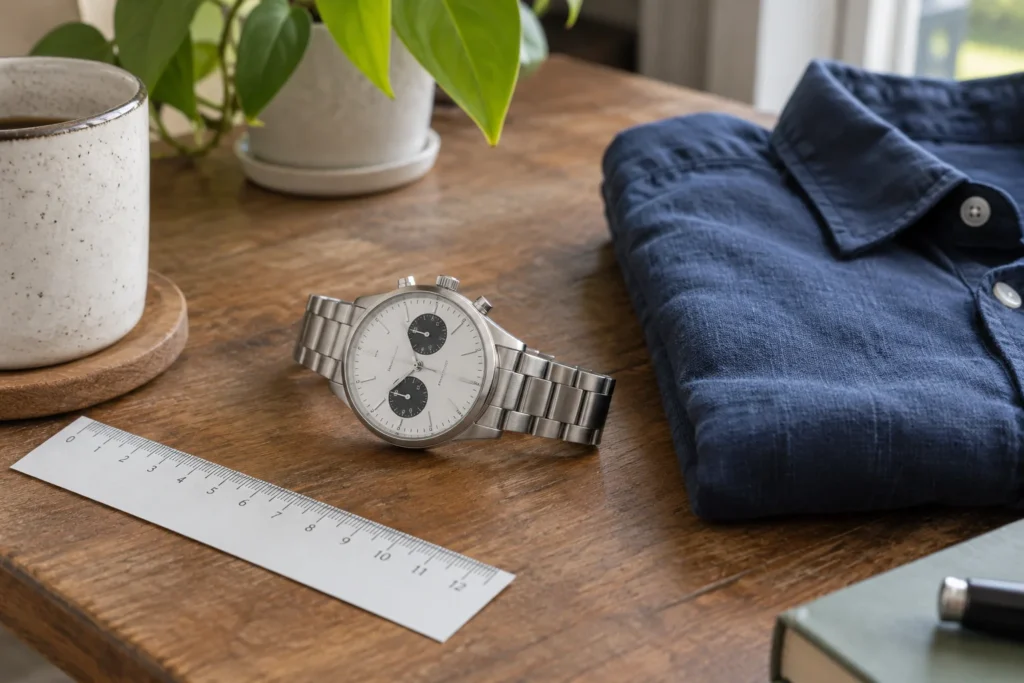
Do not compare a fictional illustration with your wrist as though it were a measured product photograph. The image here shows a generic unbranded watch to illustrate a buying decision. It is not the SSC813, and its ruler is not a scale drawing.
SSC813P1 or SSC911: compare the actual dimensions
| Buying question | SSC813P1 | SSC911 |
|---|---|---|
| Case diameter / thickness | 39.0 / 13.3 mm | 41.4 / 13.0 mm |
| Case length / lug-to-lug | 45.5 mm case length | 45.9 mm lug-to-lug |
| Lug width | 20 mm | 21 mm |
| Movement / stopwatch | V192 solar; up to 60 minutes | V192 solar; up to 60 minutes |
| Recurring costs | No quoted service price; bracelet parts, care and eventual servicing | Same categories; larger case does not establish higher upkeep cost |
| Care | Follow V192 charging and model care instructions | Follow V192 charging and model care instructions |
| Main limitation | Fit cannot be established from diameter alone | Larger diameter; not automatically a better fit or chronograph |
Sources: Seiko’s official UK SSC813P1 listing and Seiko’s SSC911 specifications. These are regional manufacturer references, not confirmations of local stock, warranty or a particular marketplace seller.
Start with the SSC813P1 if your priority is the smaller published diameter. Try the SSC911 if you prefer a larger face, but do not assume it will fit better: their case lengths are close. Both retain a busy chronograph layout. Skip both if a simple three-hand display or an automatic movement is what you really want.
3. Understand the solar routine
The SSC813 uses a solar movement, not an automatic mechanical movement. Seiko’s solar charging guidance explains that light energy is stored in a rechargeable battery. Enough light and time matter; a watch kept in darkness can run out of charge.
That is a useful distinction if you rotate several watches or keep them in a closed drawer. Read the charging instructions for Caliber V192 before planning your routine, and avoid overheating the watch while charging. Light-powered does not mean that storage and maintenance stop mattering.
Consider whether you enjoy that routine. If you wanted the experience of a mechanical watch, choose that intentionally instead of buying a solar model because it has a familiar chronograph shape. We have not measured charge behaviour, long-term accuracy or service costs.
4. Decide whether you want a chronograph
A chronograph adds a stopwatch function and more information to the dial. Seiko describes a 60-minute chronograph, a 24-hour subdial and a power-reserve indication for the V192 models on its Speedtimer page. Read the exact manual to learn how those functions operate.
If you mainly want to glance at the time, compare the layout with a simpler three-hand watch before deciding. A busy dial can be attractive without being the easiest layout for your own eyes. That is a preference to check in person, not a performance ranking we can establish from specifications.
A watch you already like may cover the same daily need. An upgrade makes more sense when the new functions, fit or appearance are things you expect to enjoy regularly. Do not buy solely because the nickname is appearing in search results.
5. Check the seller and the country
Confirm who sells the watch, what condition it is in, the documentation provided and which warranty applies. Check the seller’s relationship to the manufacturer rather than assuming that a marketplace listing establishes authorised status.
For an overseas purchase, compare delivery, import charges, returns and where service would take place. A lower headline price can become less appealing when the practical cost of returning a watch is unclear. Read Seiko’s own information for your region before paying.
Keep the invoice and reference details if you buy. If the seller cannot resolve an essential conflict in the listing, there is no need to hurry. Our deal checklist explains why choosing the item should come before evaluating a promotional price.
Sources and research limits
Our Seiko panda watch research uses Seiko’s Speedtimer overview and solar charging FAQ, reviewed on 6 October 2026. The model recommendation is based on published features and a practical buying framework, not hands-on testing, authentication of a particular watch or independent durability evidence.
The topic was selected after a US Google Trends shopping check showed rising interest in “seiko panda watch” on 6 October. A topic-level trend does not establish demand for SSC813, a seller’s stock or a likely resale value. We have not verified a current retail discount.
We compared SSC813P1 and SSC911 as two identifiable solar Speedtimer alternatives, then separated manufacturer specifications from seller claims. The official UK and Australian sources were reviewed on 7 October. We excluded the conflicting Amazon listing because its identity could not be reconciled; we excluded automatic watches from this specific solar comparison rather than treating them as inferior.
No watchmaker was interviewed. Authenticity of an individual watch, wrist comfort, bracelet adjustment, real-world accuracy and service costs remain unverified. Hands-on work would need identified samples, measured fit observations and timed operation; it cannot be replaced by an AI picture. The purchase link remains withheld until an exact buying destination is reliable.
The artwork is original AI-generated fiction, not Seiko photography or an exact retail product. We have not copied merchant images, customer reviews or star ratings. No commission-earning watch link has been added while product identity remains unresolved.