
For a first mini terrarium, choose suitable plants and a workable position before choosing the glass. A tiny jar is appealing, but the opening still needs to let you plant, remove dead leaves and make adjustments.
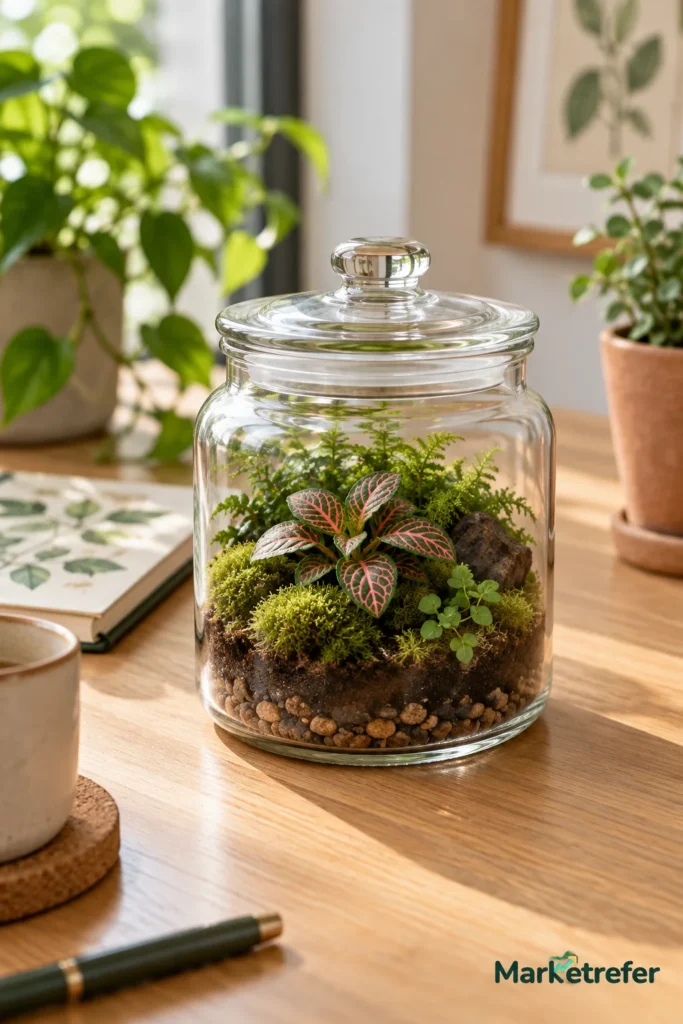
Our preference is a simple arrangement you can observe and maintain. The illustration is fictional; it does not prove that those exact plants will thrive together or that a terrarium needs no care.
In this guide
Choose open or closed first
The Royal Horticultural Society distinguishes humid closed terrariums from open containers. Small slow-growing tropical foliage suits the former; plants such as succulents need a more open arrangement.
Do not combine plants simply because their colours look good together. Match their growing conditions and eventual size. Read the plant labels and ask the supplier when a miniature variety or compatibility is unclear.
Pick a jar you can reach into
Choose clear glass with room to place and tend the plants. Very narrow openings make a beginner’s project harder. A reusable container may be enough if it is clean, stable and appropriate for the intended setup.
Measure the spot where it will sit. A container can fit a desk yet make keyboard space or cleaning awkward. Our starting choice is a small, uncomplicated vessel rather than a large kit with decorations you have no use for.
Follow a horticultural planting guide
Use the RHS instructions for selecting substrate, planting and arranging the appropriate setup. This article helps you make decisions before starting; it is not a tested step-by-step build or a substitute for care instructions for the actual plants.
Buy propagated plants from a responsible supplier. Do not gather moss or plants from land without permission. Keep the living plants as the focus and avoid overcrowding the container with ornamental pieces.
Find light without turning the jar into a sun trap
Use bright indirect light and keep the container away from direct hot sun and heat sources, following the RHS guidance and the plants’ needs. A sunny photograph is not a reliable placement plan.
Observe moisture and condensation, and adjust care to the actual arrangement. Closed does not mean permanently maintenance-free. Remove decaying material and investigate persistent problems rather than adding water on a fixed decorative schedule.
When to skip a kit
Skip a kit if it does not identify its plants, growing needs or container size. A collection of attractive pieces is not enough information to keep a living arrangement going. Buying locally may make it easier to inspect plants and ask questions.
If your desk is dark or you prefer a more forgiving first project, one suitable houseplant may be a better choice. Our small-space gardening guide starts with the conditions you actually have.
Sources and limits
We reviewed Pinterest’s hobbies report and the RHS terrarium advice linked above on 5 October 2026. The layout and styling advice is our editorial judgement. We have not tested these arrangements or products.
The photograph is an original AI-generated editorial illustration of fictional objects and spaces. It is not a merchant product photograph or evidence of a completed project. How we research · Send a correction.